
Milton Keynes Driveways & Landscaping 01908 104408 Free design
Newly laid turf lawn with planted borders

Turfing and planting

Turf is the cheapest part of a garden and the first thing to fail, because almost nobody prepares the ground it goes on.

New turf fails on compacted subsoil, which is what most new-build gardens have. Proper preparation means breaking up the compacted layer, importing screened topsoil to a real depth and laying turf the day it arrives; autumn and spring are the best times, and new turf needs daily watering for about three weeks.

Best season
Autumn and spring
Watering
Daily for ~3 weeks
Key step
Ground preparation
Preparation is the job

Turf does not fix bad ground

A roll of turf costs a few pounds. Laying it on compacted builder's subsoil, which is what most new-build gardens are, guarantees that it will look adequate for one summer and patchy for ever after.

Proper preparation means breaking up the compacted layer, importing and grading screened topsoil to a real depth, consolidating it lightly, raking to a true level and then laying turf on the same day it is delivered.

The same applies to beds. Planting into 100mm of topsoil over hardcore is the reason shrubs sulk for three years and never establish.

Beds and planting

What we do with the soft areas

We are builders rather than horticulturalists, and we are honest about the line. We will prepare ground properly, import good soil, plant to a scheme and set out mature specimens where they belong. For a complex planting design we will work alongside a planting designer rather than pretend.

  • Compacted layer broken up before any soil goes on
  • Screened topsoil to a real depth, not a dusting
  • Turf laid the day it arrives, never left rolled on a pallet
  • Beds mulched after planting to hold moisture in
  • Semi-mature trees and multi-stems set out with you on the day
  • Watering instructions that actually matter for the first three weeks
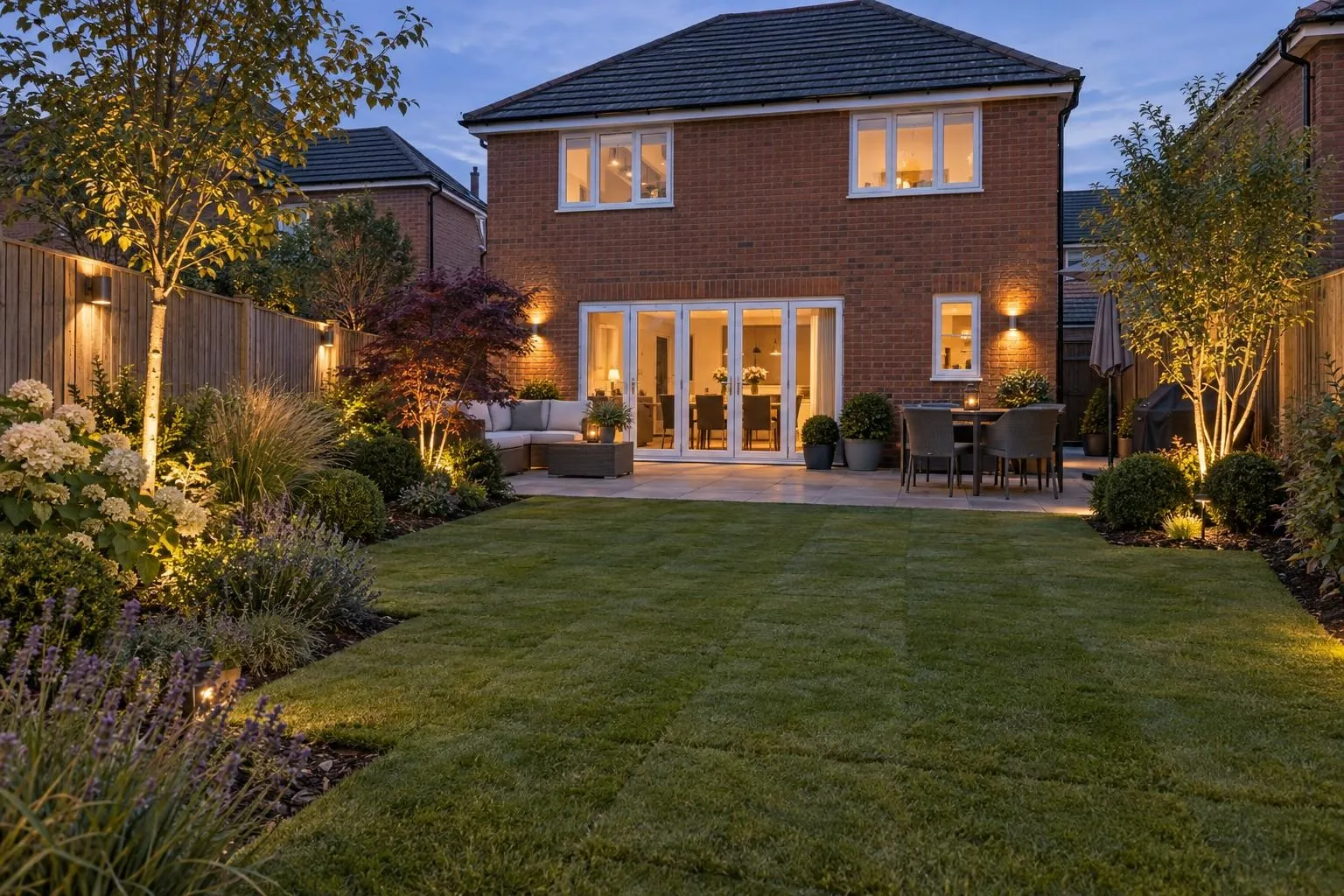
Newly laid turf lawn with planted borders
Questions

Things people ask us

When is the best time to lay turf?
Autumn and spring are ideal. Summer is possible if you can commit to watering it properly, and we will tell you plainly what that involves. We will not lay into frozen or waterlogged ground.
How much watering does new turf need?
Daily for the first three weeks unless it rains properly, and a thorough soak rather than a light sprinkle. More new lawns are lost to underwatering in week two than anything else.
Do you install artificial grass instead of turf?
We will install it where it genuinely suits — a small shaded garden, a dog run, a roof terrace. On a large open lawn we would usually try to talk you out of it, and we will explain why.
Do you maintain gardens after turfing and planting?
No. We build them. We would rather do that well than run a maintenance round badly, and we can point you at people who do it properly.
How much does it cost to lay new turf?
The turf itself is the cheap part; the cost of a new lawn is mostly in the preparation. What moves the price is how much old grass and compacted subsoil has to come out, how much screened topsoil has to be imported, the size of the area and access for barrowing it all in. It is priced as part of a fixed written quote after the free visit, rather than a per-roll rate that leaves the groundwork out.
How deep should topsoil be for a new lawn?
As a rule of thumb, a new lawn wants at least 100–150mm of good screened topsoil over subsoil that has been broken up, and beds for shrubs need considerably more, ideally 300mm or deeper. A thin dusting over compacted clay or builder's hardcore is why so many new-build lawns brown off in the first dry spell and stay wet all winter. The depth of soil matters more than the brand of turf.
Is turf or grass seed better for a new lawn?
Turf gives you a finished lawn on the day and is usable within a few weeks, which suits family gardens and anyone who wants it looking right quickly. Seed costs less in materials but takes a couple of months to thicken up, has to be kept off, and is best sown in early autumn or mid-spring. Both fail on poor ground, so the preparation underneath is identical either way.
When can I walk on and mow new turf?
Keep traffic off new turf for about two to three weeks, until a gentle tug on a corner shows it has rooted into the soil below. Give it the first mow once it has grown to around 5–7cm, on a high setting and only taking the tips off, and only when the turf is dry enough not to rut. After that, light use is fine and normal mowing can start.
Can new turf be laid over existing grass?
No, new turf should not be laid over existing grass, because it leaves a layer of rotting vegetation between the new roots and the soil, so the lawn struggles to root, stays uneven and often yellows in patches. The old turf has to be stripped, the ground broken up and levelled, topsoil added where it is thin, and the new turf laid onto that the same day it arrives.
Can you lay turf on clay soil in Milton Keynes?
Yes, turf can be laid on clay soil, but never straight onto it. Much of Milton Keynes sits on heavy clay that compacts, cracks in summer and holds water in winter, so the compacted layer is broken up first, screened topsoil imported to a proper depth and, where the ground stays wet, the drainage dealt with before laying. Turf put directly on clay looks fine for a season and then thins out.
When is the best time to plant shrubs, trees and hedging?
Autumn through to early spring is the best time to plant shrubs, trees and hedging, while the plants are dormant and the soil is moist, and it is the only window for bare-root stock. Container-grown plants can go in at most times of year if you can water them properly through their first summer. We avoid planting into frozen or waterlogged ground, and mulch the beds afterwards to hold moisture in.
Can you plant semi-mature trees or hedging for instant privacy?
Yes, semi-mature trees, multi-stems and ready-grown hedging can give screening from the day they go in, and we set them out with you so they block the view that actually matters. On Milton Keynes clay, keep thirsty trees such as willow, poplar and oak well away from the house, because roots drying out the clay can cause subsidence. Larger specimens need generous planting pits and regular watering for their first couple of summers.

Free design, free visit, free samples

We measure up, talk it through and send a written proposal with the build-up, the programme and one whole price. No pressure and no follow-up sales calls.

Call 01908 104408 Free design