

Garden lighting
For most of the year, the garden is dark when you are actually home. Lighting is the difference between a garden you look at in June and one you use in November.
Garden lighting is cheapest when the ducting goes in under the patio as it is built; adding it later means lifting paving. We design it as a scheme of a few well-placed fittings, with notifiable electrical work done and certified by a registered electrician.
- Best time
- When the base goes down
- Electrics
- Registered electrician, certified
- Guarantee
- 5 years, in writing
The cheapest thing you will ever regret
Running a duct under a patio before it is laid costs almost nothing. Adding lighting afterwards means lifting paving, chasing walls and a visible cable run.
So even where lighting is not in the budget, we will put ducting and draw cords in as the base goes down. It is a couple of hours and it keeps the option open for as long as you want it.
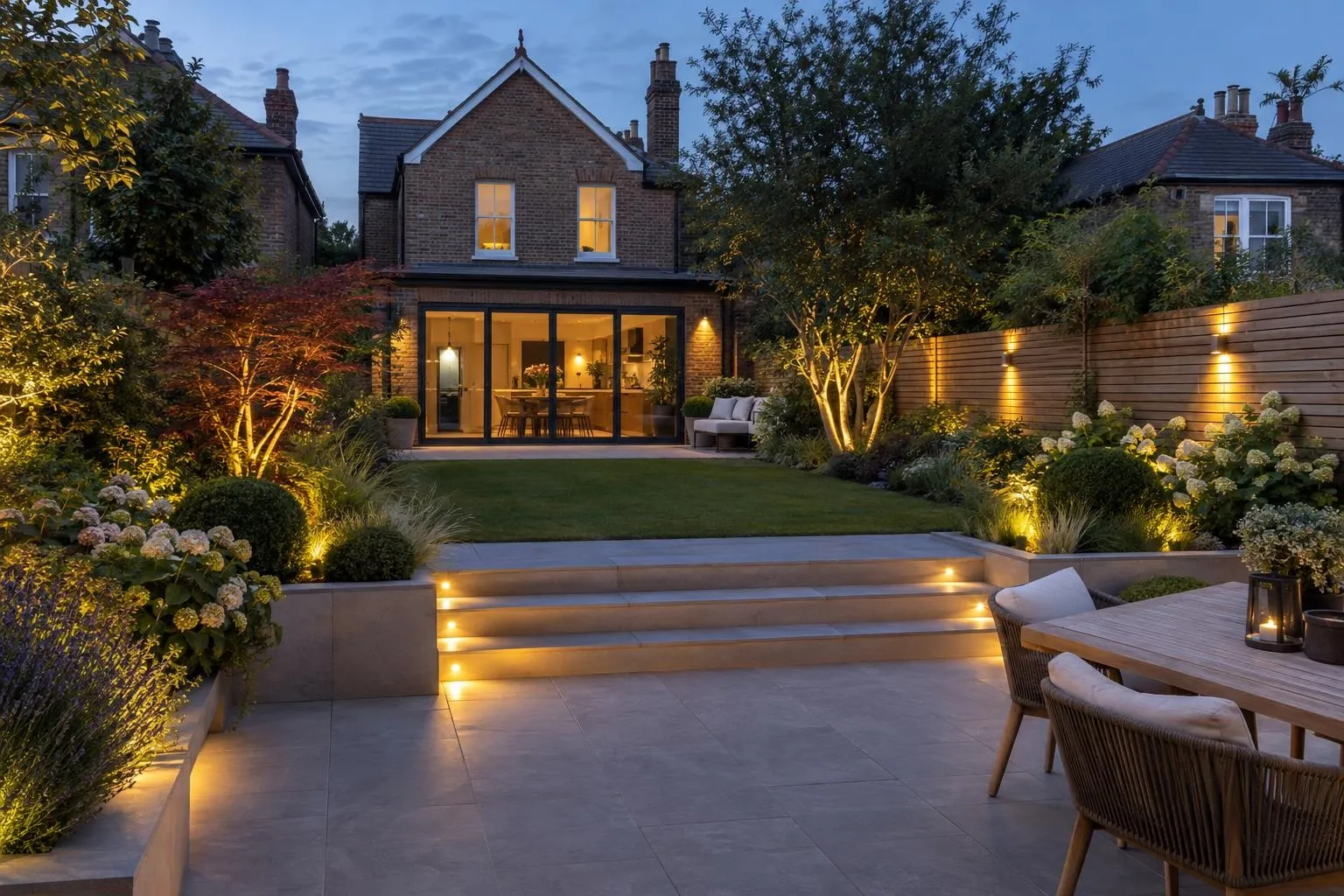
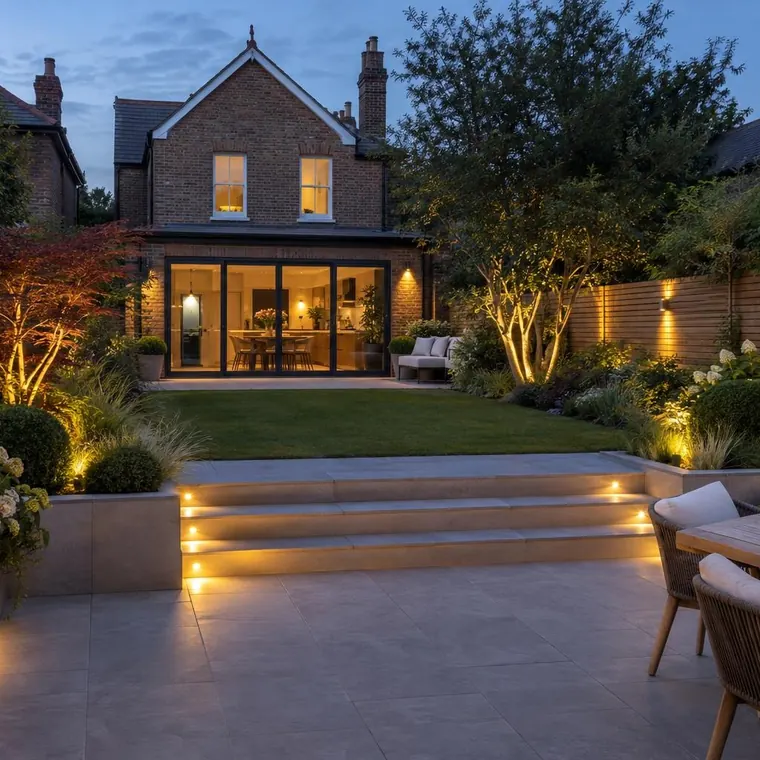
Where lighting is in the scheme, we design it as a scheme rather than dotting spike lights about. A few well-placed fittings doing different jobs beats twenty pointing at nothing.
How we light a garden
Uplight the structure
Trees, multi-stems and walls. Uplighting gives a garden depth after dark and it is the single highest-impact thing you can do.
Wash the boundaries
Grazing a slatted screen or a stone wall from close in makes the garden feel wider and hides the fence line.
Mark the changes in level
Recessed fittings in step risers and retaining walls. Safety first, but it also draws the eye through the garden.
Keep it warm
2700K as standard. Cool white makes a garden look like a car park and it makes planting look dead.
Low voltage, properly
12V systems with a transformer sized with headroom, cable buried in duct, connections in proper junction boxes.
One control
Everything on a single circuit with a timer or a smart switch, so it is one action rather than six.
The electrical side
Low-voltage garden lighting runs from a transformer that needs a supply. If there is already a suitable outdoor socket or spur, we work from it. If there is not, that is notifiable electrical work and it needs a registered electrician — we will flag it in the quote rather than leave you to discover it.
- 12V low-voltage fittings, IP-rated for external use
- Cable in duct under hard surfaces, never buried loose
- Transformer sized with spare capacity for adding to later
- Positions marked out with you on site before anything is fixed
- Tested, commissioned and demonstrated at handover
What garden lighting costs
A path, step and border lighting scheme typically costs up to about £1,500 installed, and a full multi-zone garden scheme £2,000–£6,000 or more. A new outdoor circuit is priced separately.
Garden lighting does not need planning permission, but a new outdoor mains circuit is notifiable electrical work, so it is done and certified by a registered electrician. Keep lights pointing down and away from neighbours' windows.
Guide prices from 2026 online price guides, at the higher end. Your fixed price comes in writing after the free design visit.
Things people ask us
Do I need an electrician to install garden lighting?
Is low-voltage or mains garden lighting better?
Does garden lighting need planning permission?
What colour light is best for a garden?
Are solar garden lights worth it compared with wired lighting?
When is the best time to install garden lighting?
Can lighting be added to an existing patio without lifting it?
How deep should garden lighting cable be buried?
Can garden lights be controlled from my phone or on a timer?
Will garden lighting disturb neighbours or wildlife?
How long do LED garden lights last?
Garden lighting near you
Local advice on ground, planning and prices for each town we cover.
- Garden lighting in Milton Keynes
- Garden lighting in Bletchley
- Garden lighting in Wolverton
- Garden lighting in Stony Stratford
- Garden lighting in Newport Pagnell
- Garden lighting in Woburn Sands
- Garden lighting in Bow Brickhill
- Garden lighting in Aspley Guise
- Garden lighting in Cranfield
- Garden lighting in Woburn
- Garden lighting in Hanslope
- Garden lighting in Olney
- Garden lighting in Leighton Buzzard
- Garden lighting in Winslow
- Garden lighting in Towcester
- Garden lighting in Ampthill
What garden lighting cost
Our garden lighting cost guide breaks the price down: what is included, what changes it and what to check in any quote.
Come and see one lit up
Photographs do not do garden lighting justice. If you are local we can usually arrange for you to see one after dark.